Being the youngest in our family, I didn’t really know my Dad. And as I myself age, my memories are getting fuzzier. With the 50th anniversary of his passing (2022) approaches, getting to know him much better is my personal goal.
A Different Type of Dad
Growing up, I kinda knew my Dad was different. Well, he was older than my classmates’ Dads. And he had this presence, this gravitas. My mother used to say his charisma was all about how people responded when he entered a room (well, she used to say that about Douglas McArthur, so that is saying something). And the way my cousins always looked up to him and how “his people” spoke fondly and affectionately of his management. And everyone — family, friends, staff — uniformly said that he was brilliant.
It was easy to come to that conclusion. Each time I go back to Concepcion, his birthplace, I often think about how my father managed to rise above the genteel though grueling community poverty to push himself forward. And that drive helped make him the man that he is. And also help shape his children.
The Basilio Abrera Family
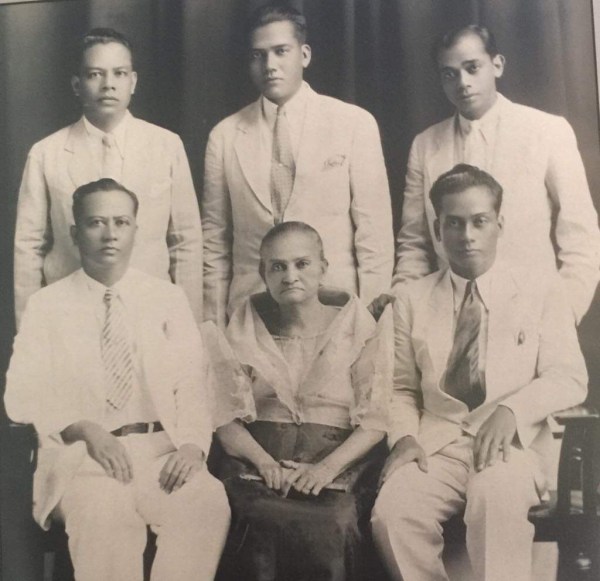
with mother Josefa and his brothers
There are different legends about Basilio and Josefa (Paez) Abrera. From pictures, Basilio looks like a true Abrera — dark, swarthy, big-eyed. He was not terribly tall it seems to me, more like many of the men born in the Philippine 19th century. There is some agreement that Basilio was born in Northern Palawan, possibly in Culion?. What we do know is that Basilio and Josefa moved from Culion to Coron, likely around 1902-1903.
Josefa was the iconic matriarch. Coming from Iloilo (a Paez), she was, according to one family legend, a fair-skinned “interna”, brought by Catholic nuns to Palawan. Did she come with the the St. Paul nuns of Culion? Somehow though, I don’t see her as a nun. Another chismis is that Josefa was previously been married to a French man who then returned to France. More, she had a daughter who eventually joined her father. A third story is that Basilio and Josefa met in Manila. While trading goods in Manila, Basilio stayed at the Paulinian dorms where Josefa served.
With all this speculation, I wonder whether anyone has ever tried checking for the birth certificates of either Basilio and Josefa, or even check out the Culion church records to trace the journey of the couple.
One thing we know for sure, Josefa was called “the Maestra” , a strict disciplinarian, who did not hesitate using the cane on her sons.
Basilio and Josefa had six children, starting with Vicenta, followed by Melquiades, Victorino, Carlos, Jose, and Bernardo. A oft-repeated story is that Vicenta eloped at a young age, marrying Captain Jose Barrientos. Basilio and Josefa were upset, her elopement caused a family rift that was not easily healed. That is perhaps the reason why we have such few pictures of the unica hija of the family.
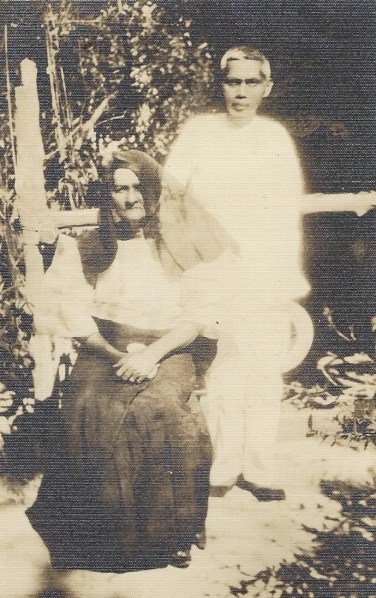
When was my father born?
My Tio Carlos stirred a hornet’s nest when he declared, at the time of my father’s funeral, that he could not have been born in 1904, as his Philippine and UN passport showed. My mother was not in any state to argue, so his cemetery marker reflected Tio Carlos’ suggested date: March 12, 1900.
Was this perhaps a mistake? Should we have just relied on his passport information? (Philippine birthdates are notoriously reliable pre-war, as records were hardly kept and the few that were there, were burned during the war).
My father placed his birthplace as Concepcion, Coron in his campaign flyer during his short unsuccessful attempt to be a delegate to the 1971 Constitutional Convention. If so, he must have been born in 1904, since the Culion relocation to Coron started only in 1902 and the barrio of Concepcion itself founded in 1904.
 My Father's Gifts
Leave a comment