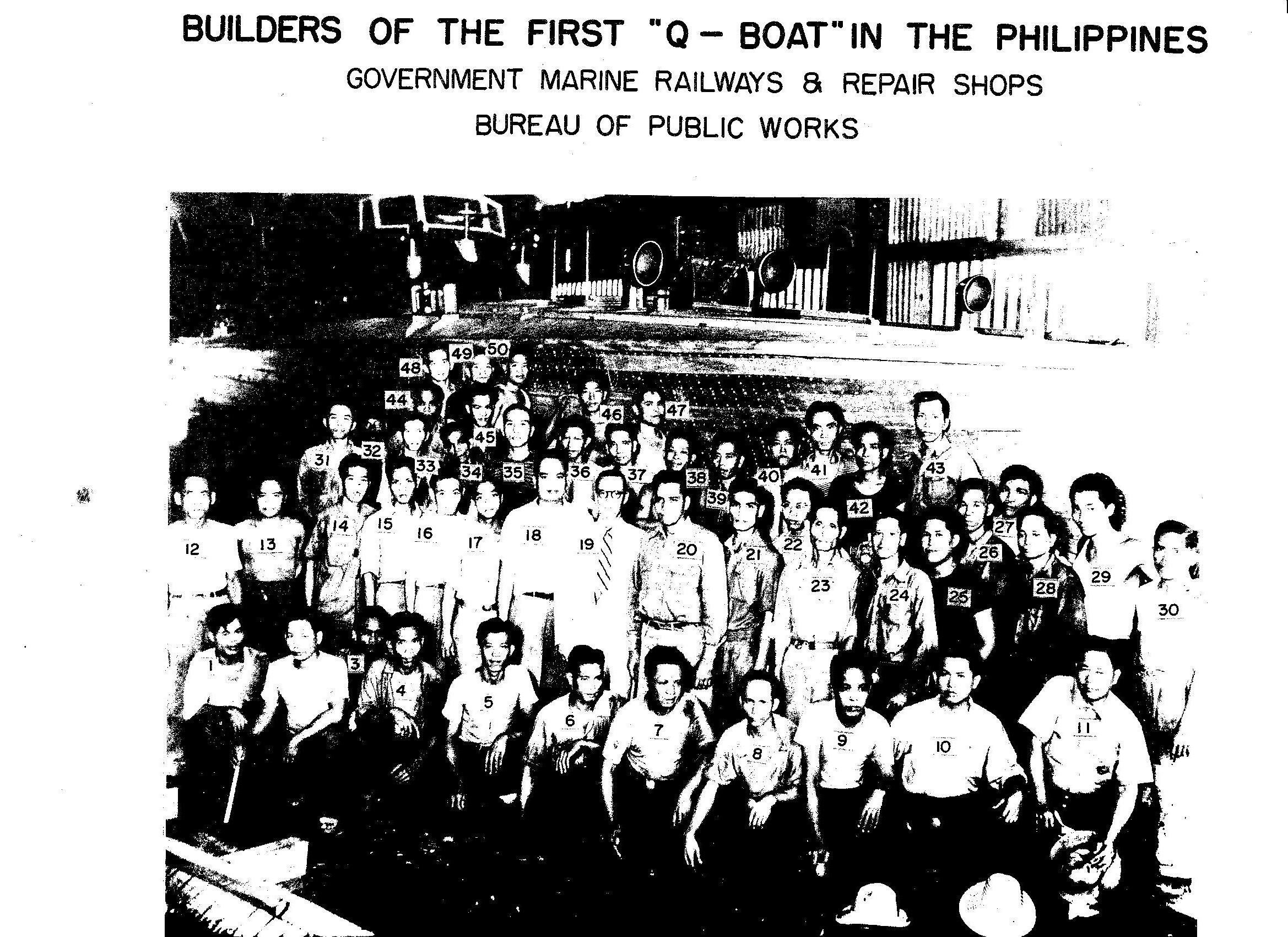
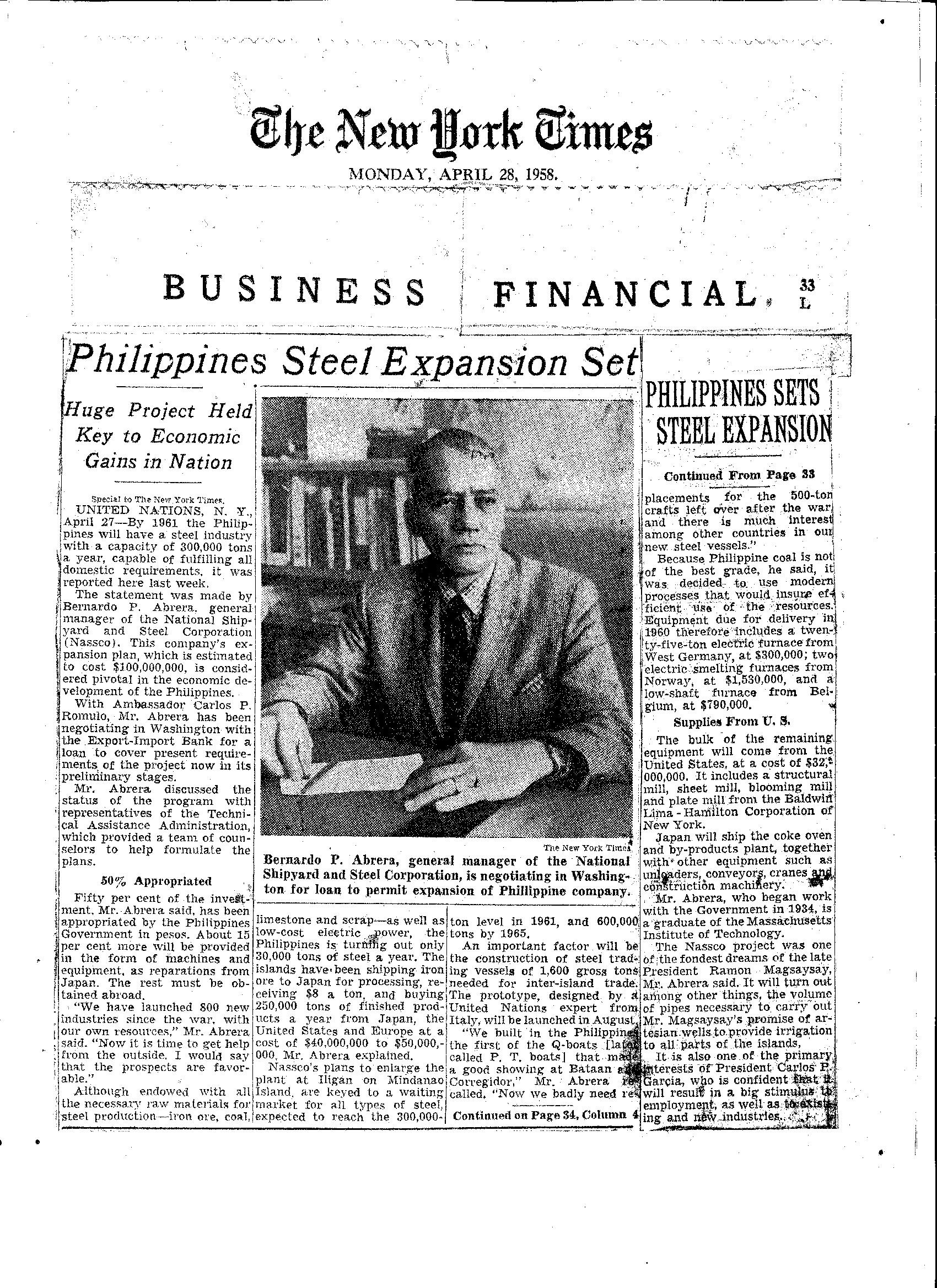
Manila was literally devastated by WW2. Independence from the Americans in 1946 propelled the country into a tremendous rebuilding effort. After being based in Tokyo as part of the Philippine Negotiation Team for reparations, my father was appointed to head the newly created National Shipyards and Steel Corporation in 1951.
Under his leadership, NASSCO contributed to the realising the vision of an industrialised Philippines. The following is a speech associated with President Elpidio Quirino in 1953 during the launching of the NASSCO DryDock. In this speech President Quirino provides the ambitious vision of post war Philippine industrialisation.
National Government Portal – edited at the Office of the President under the Commonwealth Act No. 638.
Transcription of the Extemporaneous Remarks of the President at the Inauguration of the NASSCO Shipyard in Mariveles, Bataan, March 31, 1953. Posted on March 31, 1953
Ladies and Gentlemen:
At long last I am relieved of the continuous anxiety that brought me hereto less than a dozen times in the recent past to see that this dry dock is completed.
We meet here, brought together by a new human concept which is totally different from the old concept of what would be realised in this vicinity. During the early part of the Spanish administration as well as during the whole period of the American occupation, this area was conceived to be an area dedicated dated to national defence. This channel between Corregidor and Mariveles was supposed to be a naval Thermopylae by which to keep the invader who would penetrate toward Manila Bay and crush the Philippines through its capital. That continued to be the concept of previous administrations up to the last world war.
One afternoon, contemplating the crossfire between Corregidor and Mariveles during the last few days of the conquest these islands by the Japanese when we used to get together along the beach of Manila Bay to see not only the beautiful sunset which has made Manila famous or Corregidor renown(ed), but the exchange of fire and flashes from the mouths of the guns that were exchanged between Corregidor and Bataan during these latter days of the Occupation, we realised then not only the beauty of the sunset but the furious exchange of fire between two enemy guns in Corregidor and in Bataan.
But when the Philippines was eventually retaken by the United States, there was a new concept, a new vision, a new inspiration that set in our mind, in the wake of the granting independence which was then given to us to give Us an opportunity to develop this land in accordance with our own genius, our own inspiration, and our own effort.
That change of concept has conceived this vicinity as an industrial district, no longer as we discovered during the last world war to utilise that channel for national defence purposes but to use it as a gateway to Manila in order to open new facilities such as the building of a new dry dock supposed to be the biggest in the Orient and which would give us a basis for our industries and encourage the development of the maritime industry. It is true that we first encouraged maritime shipping by the acquisition of three ocean-going vessels , one of which is the Dona Aurora which brought many of you here. But it is also true that something was conceived to be of greater and far-reaching importance than the mere acquisition of ocean-going vessels.
We conceived a new, entirely new idea for the establishment of basic industries as the secret of a new venture at industrialization. We thought of building hydroelectric plants. We thought of establishing a fertiliser plant. We thought of promoting and establishing more irrigation systems. We thought of establishing this shipyard as a basic industry necessary to promote and, to some extent, develop industries connected to these basic industries and to supply actual requirements of the industries to be organised under this impetus.
For long, long years, and until lately, our country has been regarded only as a producer of raw materials to supply the requirements of industrial countries. We have refused for some time to accept that role in our economic development ent but have not been able tp show that we can also develop our country industrially. But nowadays, after having established so many industries in the Philippines, inviting foreign capital to make investments here in order to multiply our industries, many new industries have been established. There are now 165 new tax-exempt industries in the Philippines.
We wanted to go farther by establishing these basic industries to show that this country and make a complete change in. our economic activities — from an agricultural country to an industrial one. But we do know that there are so many products we are producing here that need to be industrialised because of we can continue to produce export products it would simply mean enslavement by industrial countries which we only supply with raw materials.
And, my friends, the establishment of this dry dock in Mariveles is one of the means to show that the country can be industrialized. There are one thousand and one reasons to convince us that the establishment of a dry dock will save not only dollars but at the same time the necessity of having to go abroad for the purpose of repairing ships which we are in daily need of increasing or extending the volume in order to cope with international commerce, especially with the products that need to be transported more economically than before , in view of keen world competition.
The establishment of the dry dock, therefore, is part of a huge program of development. It is not only because of the insistence of Colonel Bautista and Mr. Abrera that I decided to establish here or approve the establishment of this shipyard that we are inaugurating this day. It had to form part of the general program of development , a program which I ambitiously called total economic mobilisation program (bold letters, mine).
Those who deride the program, those who disparage the results, those who fail to see from the afar or through the future the great advantages of following the program, will begin to realise this year that this program is not a mere theory. It is not a mere philosophy, it is not a mere vision, it is not a mere shibboleth to attract people together or give them more confidence on the effectivity of the program of development that we have adopted.
This year we are inaugurating not only this shipyard but also the fertiliser plant as well as the hydroelectric plant in Maria Cristina, Lanao. This year, we will also inaugurate the steel mill in the same vicinity, and during the latter part of the year we will also , be inaugurating another branch of the cement plant in La Union.
In our program of economic development, therefore we have tried to cover all necessary preparations by establishing basic industries to make the country industrially able to meet our requirements in order to supply the needs that have been supplied by foreign importers.
Ladies and gentlemen, it is a great pleasure, it is a great source of pride, and it is a great incentive to the country to see the plant established here, the dry dock that is being inaugurated today. History will record our great efforts in this epoch.
When before, dreaming was the only thing about development in our mind, ten or twenty years hence, when we review the steps taken today, since America gave our freedom on July 4, 1946, we shall be able to show real Filipino genius, determination, and capacity to stand the criticism of any generation. I hope that with this auspicious beginning, as the years go by, we will increase all these evidences of the capacity of the Filipino people not only to maintain their name and prestige in world affairs.
And, my friends, I congratulate those who have initiated the establishment of this dry dock and those who have effectively cooperated in the realisation of that plan.
This is one of the greatest examples of cooperative effort on the part of the government. I hope that from now on there will be less talk and more work, there will be more concentrated effort in our constructive activities and less criticism, and there will be more sensible thinking people rather than silly political talks in our midst (applause).
Ladies snd gentlemen, I want you to take stock of, analyse, interpret, and realise in conscience what is being done for you. This dry dock alone, you may not know how many laborers will be employed here. No less than three thousand, three thousand of the numerous labourers displaced from offices in Manila. In our effort to economise, we reorganised government corporations and reduced their number. We now only have 23. We used to have more than 30.And as people who were discharged have to be accommodated somewhere, we have to create more opportunities, we have to open more lands, and we have to establish industries in order to give them opportunities for employment elsewhere, in order to reduce the unemployed.
With 165 new industries, do you know how many of the unemployed are being accommodated? The lands we are opening, are now being settled by them. Do you know how many people are being given lands and homes in order to have the capacity to produce and provide wherewithal for each family? Do you know that the efforts we are making in building this country are of a wide range which were not conceived during those days of idealism, when we were just crying loud to the sky asking Heaven to give us the freedom that we need? Those days of idealism are gone.
These days are days of hard work, and I invite you, my friends, to realise the importance of the project we are now realizing because this spells the future capacity of the Filipino people to stand on their own feet, with their own government and with the opportunity to establish here a firm, strong foundation upon which we could base the continued enjoyment of our liberty and freedom. Thank you very much (Applause)
Source: University of the Philippines, College of Law Library






 My Father's Gifts